

Townhouse, Defined: Where It Actually Sits Between a House and an Apartment
No, a townhouse isn't a duplex, though the two get confused for an understandable reason: they're both attached homes, and the terms get used loosely in listings. The short version is that they're answering different questions. «Duplex» is about unit count. «Townhouse» is about the building's structure. Here's what that actually means, and how a townhouse compares to a standard apartment or a detached house too.
Is a Townhouse a Duplex?
Not by definition. A townhouse is defined by layout and structure, an attached, multi-story home sharing at least one wall with a neighboring unit, with a private entrance directly from the street rather than a shared hallway. A duplex is defined by something else entirely, unit count, specifically two. Our guide to what a duplex apartment actually means covers that side of the comparison in full. The two categories overlap only when a two-unit building happens to be built in townhouse style, in that specific case, it's accurate to call it both, but a row of ten townhouses is still ten townhouses, not ten duplexes.
What Exactly Is a Townhouse?
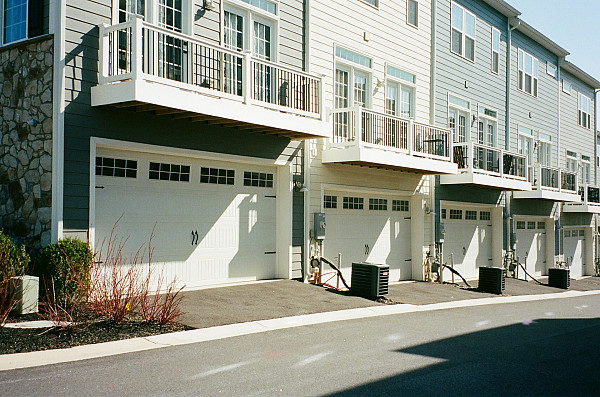
A townhouse is an attached home, usually two or three stories, sharing one or more walls with the unit next door, with its own private entrance and often a small yard, patio, or garage. On the East Coast, particularly Philadelphia and Baltimore, the same style of home is often called a «rowhouse» instead, and the two terms overlap heavily in everyday use, but they're not perfectly identical. «Rowhouse» tends to imply a uniform, identical facade repeated across the row, the classic 19th- and early-20th-century mid-Atlantic layout, while «townhouse» can describe units with more varied design within the same development and gets used more broadly across the country, including for newer construction. What separates either one from an apartment or a duplex unit is the combination of multiple floors and a private, ground-level entrance that a single-story or shared-entrance unit doesn't have.
What's the Difference Between a Townhouse and an Apartment?
An apartment is typically a single-level unit inside a larger building, reached through a shared hallway, stairwell, or elevator, and managed centrally by one landlord or property company for the whole building. A townhouse gives you your own front door directly to the outside, often multiple floors, and in many cases a small private outdoor space that a standard apartment doesn't include. The trade-off runs the other way too: an apartment building typically centralizes maintenance and amenities under one management company, while a townhouse, depending on whether it's part of an HOA, can mean more direct responsibility for your own unit's upkeep. If you're weighing this trade-off more broadly, our guide to renting a house versus an apartment covers many of the same considerations, privacy, maintenance responsibility, shared walls, that apply here too.
What's the Difference Between a Townhouse and a House?
A single-family house is fully detached, no shared walls with a neighbor on any side. A townhouse shares at least one wall, sometimes two if it's in the middle of a row, which is the core structural difference between the two. That shared wall has practical consequences: more noise transfer between units than a detached house typically has, and usually a smaller footprint and lot, since townhouses are built to fit more homes into less land than standalone houses require. What a townhouse keeps from the single-family house side of the comparison is the multi-story layout and private entrance. It's genuinely a middle category, not just a smaller house or a nicer apartment.
Do Townhouses Always Have an HOA?
Often, but not always. Because townhouses share walls and sometimes common areas like a shared driveway, walkway, or exterior grounds, a homeowners association that maintains those shared elements and enforces exterior appearance rules is common, but it isn't a defining feature of the term itself, and some townhouse developments are individually maintained with no HOA at all. If HOA involvement matters to you, confirm it for the specific property rather than assuming based on the word «townhouse» alone, since this varies by development and isn't something renting versus buying changes on its own.
Can You Rent a Townhouse, or Are They Only for Sale?
You can rent a townhouse just as easily as you can rent an apartment or a house. The term describes the building's structure, not who owns it or whether it's available for purchase versus lease. Some townhouses are owned by individuals and rented out directly, similar to how a private landlord might rent out a single-family house, while others are part of larger developments managed more like an apartment complex. Whatever the arrangement, our guide on what should be in a residential lease is worth checking before you sign, since a townhouse lease should cover the same core terms as any other rental, plus clarity on HOA rules if they apply.
If you own a townhouse and are weighing whether to rent it out yourself, you can list it directly on Yonfi rather than going through an agent.
FAQ
Is a rowhouse the same as a townhouse?
Close, but not perfectly identical. The terms overlap heavily and are often used interchangeably, especially outside real estate-specific contexts. «Rowhouse» is more common on the East Coast, particularly Philadelphia and Baltimore, and tends to imply a uniform, identical facade across the row, the classic 19th- and early-20th-century layout, while «townhouse» more broadly can include units with varied design within the same development.
Is a townhouse the same as a duplex?
No, duplex refers to a two-unit building, while townhouse refers to an attached, multi-story home with a private entrance. A two-unit building can be built in townhouse style, but that's a specific overlap, not the general rule.
What's the difference between a townhouse and a duplex apartment?
Townhouse describes the building's structure, attached, multi-story, private entrance. «Duplex apartment» describes something else, unit count or an internal two-floor layout depending on the market. A townhouse can exist independently of either meaning, since it's answering a different question, building shape, not unit type. See our guide to duplex apartments for the full breakdown of that side.
Is a townhouse bigger than an apartment?
Often, since townhouses typically span multiple floors rather than one level, but this varies enough by specific property that it isn't a reliable rule. Compare actual square footage rather than assuming based on the category alone.
Is a townhouse the same as a condo?
No, condo refers to an ownership structure, not a building shape, so a condo can be a single-story unit in any type of building, including a townhouse. A townhouse describes the physical structure, and it can be sold or rented either as a condo or with the land underneath it directly owned. Our guide to what's actually different about renting a condo goes deeper on how that ownership structure works and how it differs from a standard rental.
Three Different Questions, Not One
The short version worth remembering: duplex and condo describe ownership and unit count, townhouse describes the physical shape of the building itself. Once those questions are separated, most of what makes «is a townhouse a duplex» or «is a townhouse a condo» confusing stops being confusing, they were never actually the same kind of question.